
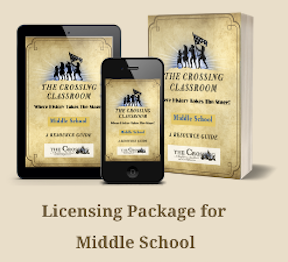
The Crossing Classroom Middle School - Perfect for Civic Education!
Licensing these music-based resources gives middle schools legal, high-quality songs, lyrics, recordings, and classroom materials that teachers can confidently use. It turns abstract founding principles—liberty, civic duty, courage, sacrifice, and freedom—into emotionally resonant experiences for 11–14-year-olds.
Music and diverse character perspectives (soldiers, families, women on the home front, and voices like Jacob) make history stick. Songs boost retention through melodies, spark empathy by letting students feel the era’s hope, fear, and determination, and build critical-thinking skills as students analyze viewpoints, symbolism, and themes.
Licensed materials ensure legal use, standards alignment, professional production, and flexible activities like discussions, role-playing, and writing prompts—transforming passive learning into active civic education that creates engaged, thoughtful citizens.
Description
Licensing these music-based resources (such as songs, lyrics, recordings, or accompanying materials) provides schools with legal, high-quality, ready-to-use content that teachers can confidently integrate into middle school classrooms. This approach transforms abstract founding principles—like liberty, civic duty, courage, sacrifice, and the meaning of freedom—into something emotionally resonant and memorable for 11–14-year-olds, who often struggle with dry textbooks or complex primary sources.
Why Music and Character Perspectives Work Especially Well for Middle Schoolers
Middle school students thrive on multi-sensory, story-driven learning that connects to emotions and personal relevance. Your described material does exactly that by blending:
- Historical context (Washington’s leadership challenges, soldier morale, wartime strategy)
- Primary-source connections (excerpts and ideas from Thomas Paine and the Declaration of Independence)
- Multiple perspectives (soldiers, civilians, women on the home front, and diverse voices like Jacob’s experience)
Music makes these elements stick. Research and classroom practice show that songs help students:
- Retain information better — Melodies and rhythms act as powerful mnemonics, making facts, dates, and ideas easier to remember than rote reading.
- Engage emotionally — Students don’t just learn about the emotional reality of the Revolutionary era (fear, hope, exhaustion, determination); they feel it through lyrics and performance. This builds empathy and deeper understanding of why people sacrificed for founding principles.
- Analyze like historians and literary critics — Lyrics naturally invite examination of point of view, author’s purpose, figurative language, symbolism, and theme—skills already in English/language arts and social studies standards.
- Spark discussion and critical thinking — Songs from different character perspectives encourage students to compare viewpoints, debate ideas like “What does freedom really mean?”, and connect past events to today.
Similar approaches (e.g., using Revolutionary-era songs, Hamilton-style musicals, or modern songs paired with history) have proven effective at boosting student interest, attentiveness, and even test scores in U.S. history classes.
How Proper Licensing Specifically Helps Bring This to Middle School Classrooms
Licensing ensures the resources are school-ready and maximizes their educational impact in these practical ways:
1. Legal Peace of Mind for Teachers and Schools
Copyright-protected music can’t be freely copied, performed publicly, recorded for classroom use, or shared digitally without permission. A proper license (often available through educational or performance rights organizations) removes barriers so teachers can:
- Make classroom copies of lyrics or sheet music.
- Play recordings.
- Have students perform or analyze the songs.
- Incorporate them into projects, videos, or virtual lessons.
This prevents accidental infringement while giving educators full access.
2. Reliable, Standards-Aligned Materials
Licensed resources are typically professionally developed with accuracy in mind. They directly support your listed themes (leadership, sacrifice, civic duty, courage, freedom) and connect to primary sources like Paine’s writings and the Declaration. Teachers save hours of prep time hunting for or creating their own content, allowing more focus on facilitation and student engagement.
3. High-Quality Production That Captivates Students
Good recordings, thoughtful lyrics, and character-driven storytelling make history vivid and relatable. Middle schoolers respond strongly to music—they listen to it constantly in daily life—so professional tracks feel modern and exciting rather than “school-y.” This increases buy-in and helps diverse learners (including those who struggle with traditional reading) access the content.
4. Flexibility for Multiple Teaching Strategies
With licensed materials, educators can easily facilitate:
- Listening activities followed by analysis of figurative language and symbolism.
- Role-playing or discussions from different character perspectives (e.g., a soldier vs. a woman on the home front).
- Writing prompts connecting lyrics to founding principles (“How does this song show the idea of ‘unalienable rights’ from the Declaration?”).
- Cross-curricular links between history, ELA, and even music class.
5. Scalability and Sustainability
Licensing often allows district- or school-wide use, so one set of resources can benefit many classrooms. It also supports extensions like student performances, assemblies, or online sharing (within the license terms), turning passive learning into active civic education.
Bottom Line for Middle School Learning
Licensing these resources removes friction so teachers can focus on what matters: helping students encounter the human side of the American founding—not just memorize facts, but understand the real struggles, diverse voices, and enduring principles behind events like the Revolution. Through music, abstract ideas like civic duty and freedom become personal and powerful, fostering the kind of engaged, thoughtful citizens our founding principles aimed to create.
If your materials include specific songs, a teacher guide, or recordings, licensing them positions the package as a complete, classroom-tested tool that aligns perfectly with middle school standards while making history unforgettable. This is far more effective than hoping teachers will piece together public-domain songs or risk copyright issues with modern tracks.
Included in the Crossing Classroom Middle School Package
Middle School
Educational resource guide to stimulate Q & A, foster cooperative learning, & engage students in fun activities about this historical moment in time!
Script & stage directions for the teacher to use in many ways
Six (6) Karaoke tracks for students to listen to and sing!
Six (6) demo videos
Printable Activity Sheets
Lyric Sheet for all six (6) songs
Middle School will additionally include: Music Score with P/V and Lead Sheets for Three (3) songs if a choir wants to perform
One (1) resource guide
One (1) Script
Song lyric sheet for 6 songs
Additionally for the Choir teacher if they want to perform songs:
Music Score with P/V and Lead Sheets for Three (3) songs if a choir wants to perform